How can assets confiscated from organised crime become tools for social inclusion, democratic participation and community development?
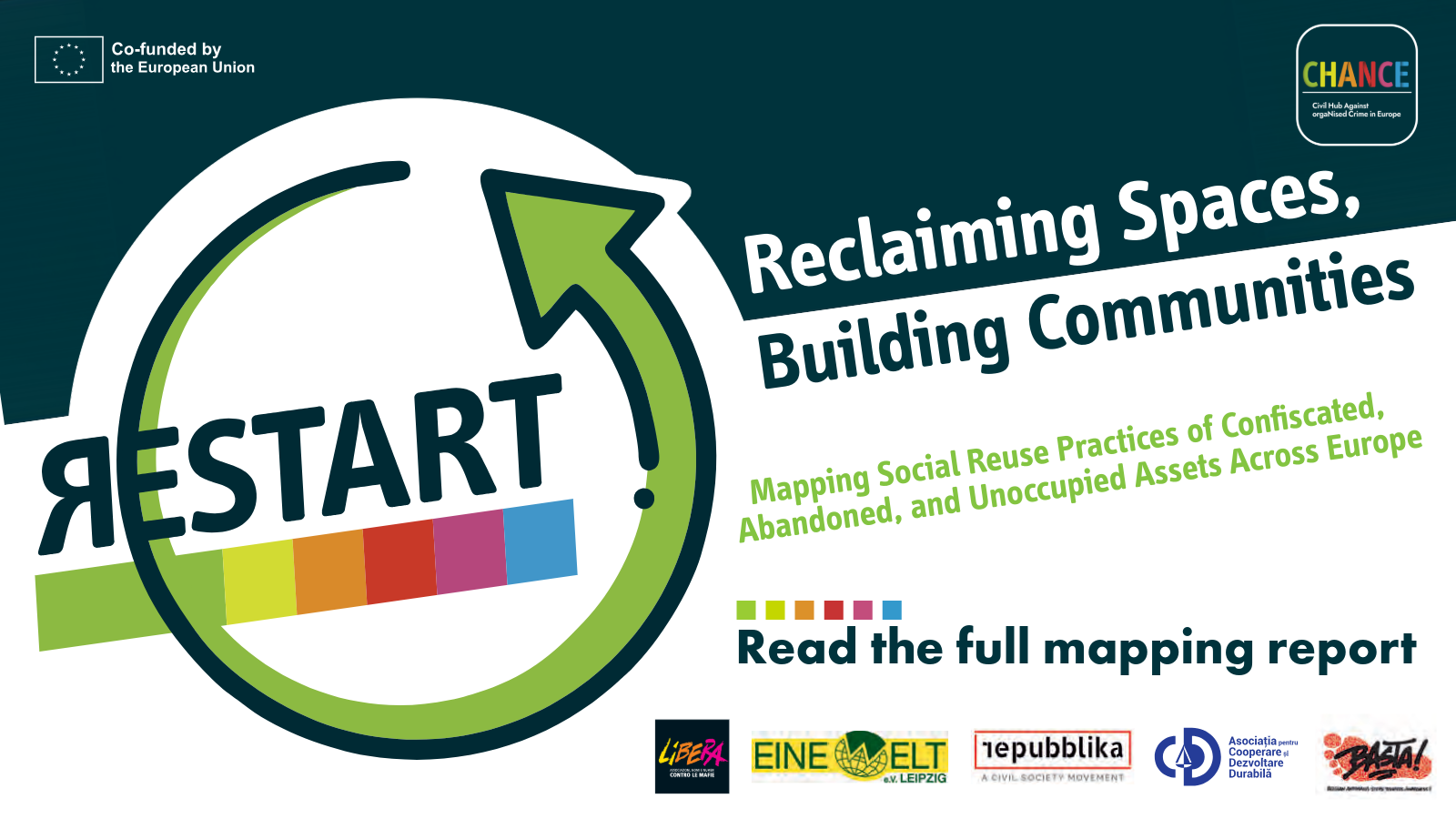
The newly published RESTART Mapping Report seeks to answer this question by examining experiences of social and public reuse in five European countries: Belgium, Germany, Italy, Malta and Romania. Developed within the framework of the European project RESTART – A new paradigm to protect the EU core values and strengthen democratic participation through the public and social reuse of assets, the report provides a comparative overview of how abandoned, unused and confiscated properties can be transformed into resources for the common good.
The research shows that social reuse practices have reached different levels of development across Europe. In Italy, the social reuse of confiscated assets has become a well-established instrument for promoting legality and combating organised crime. In other countries, where specific legal frameworks are still emerging, many of the most innovative experiences involve the temporary or permanent social reuse of vacant and abandoned buildings. Despite these differences, the cases analysed reveal common goals: strengthening communities, fostering civic participation, creating opportunities for vulnerable groups and regenerating neglected urban and rural spaces.
At the same time, the report identifies several recurring challenges. Bureaucratic delays, limited access to funding, difficulties in managing large properties, and varying levels of community engagement often affect the long-term sustainability of reuse projects. Nevertheless, the research highlights the crucial role played by civil society organisations, local communities and social economy actors in driving positive change and ensuring that recovered assets generate lasting public value.
A key element of the report is its analysis of the opportunities created by Directive (EU) 2024/1260 on asset recovery and confiscation. The Directive encourages Member States to develop strategies for the public and social reuse of confiscated assets, recognising their potential contribution to crime prevention, social cohesion and territorial resilience. The experiences documented in the report demonstrate that effective reuse is not only a matter of asset management, but also a powerful mechanism for strengthening democratic values and the rule of law.
About the RESTART Project
RESTART is a European project co-funded by the European Union under the Citizens, Equality, Rights and Values (CERV) Programme (Project ID: 101146600). The project is coordinated by Libera. Associazioni, nomi e numeri contro le mafie and implemented together with members of the CHANCE – Civil Hub Against orgaNised Crime in Europe network:
- Libera (Italy)
- Eine Welt e.V. (Germany)
- Repubblika (Malta)
- ACDD (Romania)
- BASTA! (Belgium)
Through research, advocacy, capacity-building activities and international exchanges, RESTART aims to promote active citizenship and democratic participation through the reuse of confiscated, abandoned and unused assets. One of its most distinctive features has been the organisation of international youth camps and exchanges, enabling participants to explore practical experiences of social reuse and community-led regeneration across Europe.
Research Methodology
The Mapping Report is the result of a collaborative research process involving all project partners.
Following an initial identification of relevant social reuse experiences in each participating country, the partnership jointly selected a series of case studies based on shared criteria. A common interview framework was then developed, allowing partners to conduct semi-structured interviews with organisations, public institutions and stakeholders involved in the management of the selected assets.
The collected data were analysed through a shared methodology, enabling the comparison of experiences across different national contexts. The result is a unique European overview that highlights both the diversity of social reuse models and the common challenges and opportunities facing organisations working to return assets to communities.
The report confirms that social and public reuse can serve as an effective response to organised crime, abandonment and social exclusion, while contributing to stronger, more inclusive and resilient communities throughout Europe.
Download the Report
💾 DOWNLOAD HERE: RESTART Mapping Report – Good Practices on Public and Social Reuse of Assets in Europe
The views and opinions expressed in this publication are those of the authors only and do not necessarily reflect those of the European Union or the European Education and Culture Executive Agency (EACEA). Neither the European Union nor EACEA can be held responsible for them.